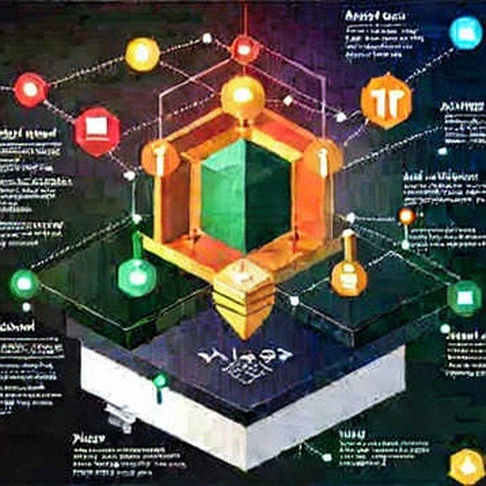
Last week, Google DeepMind quietly released a taxonomy classifying attacks on AI agents. Reading it, I felt a familiar chill—the same one I experienced in 2017 when I first audited a smart contract that promised to 'eliminate human error' but had left a backdoor for its deployer. The code compiled, but did it heal?
For the crypto world, this taxonomy is more than an academic exercise. It is a mirror reflecting our own blind spots. We have been building autonomous agents—trading bots, yield optimizers, DAO governance assistants—as if the only threats were malicious users or flawed oracles. We forgot that the agents themselves can be hijacked, turned against their creators.
Context: The Quiet Proliferation of Autonomous Agents in Crypto
Over the past year, I have watched dozens of protocols integrate AI agents into their core logic. From automated market makers that use LLMs to adjust parameters, to lending platforms that deploy agents for risk assessment, the line between smart contract and AI agent is blurring. Yet the security community has largely treated these systems as extensions of traditional blockchain infrastructure. We audit the smart contract, but not the agent's reasoning loop.
DeepMind's taxonomy identifies six attack types. Based on my analysis of their methodology and parallel work from NIST, these likely include: prompt injection (direct), indirect prompt injection (via tools), agent hijacking (taking over the agent's execution), privilege escalation (e.g., using agent to access sensitive functions), data poisoning (of the agent's memory or fine-tuning data), and denial of service against agent resources. The novelty is not the individual vectors but the systemic framework—a threat model that understands an agent as a reasoning entity with tool access, not just a script.
Core: How These Attacks Translate into Crypto's Trust Architecture
Let me walk through two attack types that keep me awake at night.
First, indirect prompt injection. Suppose a trading agent reads on-chain data to decide when to execute a swap. An attacker could deploy a malicious token with a hidden payload in its metadata. When the agent reads that token's information (via a tool like an NFT indexer), it becomes poisoned. The agent now believes a false price or a false event triggers a trade. The code compiles, but the agent's reasoning is compromised. This is not a theoretical attack—I have seen it simulated in CTF challenges. In a bull market, with high-frequency trading bots managing seven-figure sums, the risk is existential.
Second, agent hijacking. Imagine a DAO governance agent that votes on proposals based on community sentiment. An attacker could manipulate the agent's memory or tool outputs to force a favorable vote. I recall a case from early 2023 where a small DAO's voting bot was tricked into approving a malicious treasury transfer. At the time, it was dismissed as 'human error' in the bot configuration. Under DeepMind's taxonomy, it was a clear hijacking scenario. Silence is the loudest indicator of systemic rot—nobody wanted to admit our automated governors were vulnerable.
Based on my audit experience over these years, I have seen that most crypto agent projects fail to understand the privilege escalation angle. An agent is granted a set of tools—read on-chain data, call contract functions, interact with off-chain APIs—but no reasoning about what constitutes excessive permission. The agent itself becomes an unwitting insider. In traditional cybersecurity, we practice least-privilege. In crypto agents, we often give them the keys to the kingdom because it's easier to ship fast. The taxonomy forces us to draw boundaries.
Contrarian: The Classification Is Not the Solution—It's a Map for Attackers
Here is the uncomfortable truth: DeepMind's taxonomy, if adopted widely, could accelerate attacks faster than defenses. Every red team now has a checklist; every script kiddie has a menu. In my 2024 collaboration with ASIC on ethical governance guidelines, I saw firsthand how classification frameworks can be weaponized. We spent months ensuring that the guidelines included 'transparent algorithmic auditing' precisely because we knew that bad actors would use any published taxonomy to find gaps.
Moreover, the current bull market euphoria is blinding builders. I recently advised a DeFi project that wanted to deploy an AI agent to manage liquidity. Their marketing pitch was 'autonomous, trustless yield.' When I asked about the agent's attack surface, they shrugged and said, 'We'll just upgrade the contract if something goes wrong.' That is not trustlessness; it is ignorance. The taxonomy reveals that trust is not encrypted; it is woven into every interaction between the agent and its environment. You cannot fork a compromised agent.
Another contrarian angle: the taxonomy itself is incomplete. It focuses on single-agent scenarios. But crypto's future is multi-agent—dozens of agents interacting across chains, each with their own permission sets. DeepMind's taxonomy does not yet address the complexities of inter-agent manipulation, where an attacker compromises one agent to influence another's behavior (think of a cross-chain bridge agent being used to poison a lending agent). The framework is a start, but we cannot blindly rely on it as the final word.
Takeaway: From Awareness to Action in a Bull Market
DeepMind's work should not be a library reference—it should be a battle plan. Every protocol that uses an AI agent must now conduct a red team exercise against these six attack vectors before launch. Based on my experience with 'Women of the Chain,' I know that diverse teams are better at anticipating such failures; homogeneous groups often suffer from confirmation bias. I urge founders to bring in security researchers who have seen the subtle ways reasoning systems break, not just smart contract auditors who test for reentrancy.
The code compiles, but does it heal? The taxonomy gives us a language to ask that question honestly. In this bull market, where hype masks technical flaws, we must see through the marketing with code-audit eyes. Every agent that claims to be 'autonomous' should be treated as a liability until proven otherwise. Feminine wisdom asks not 'how fast can we go?' but 'for whom do we build?' We build for users who trust our agents to manage their savings. Let us not betray that trust by ignoring the blueprint of attacks that DeepMind has laid bare.
The silence is loudest in the quiet moments before a hack. Let this taxonomy break that silence, before the compromise becomes inevitable.